
Drawbacks Of Unregulated Capitalism


Drawbacks of Unregulated Capitalism

Introduction-

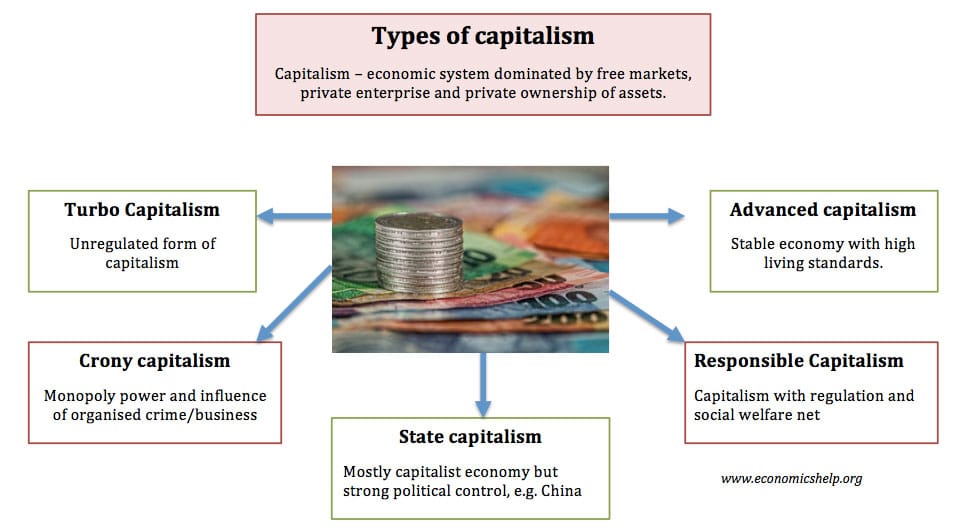
Capitalism- Capitalism is an economic system dominated by free markets and private ownership of wealth, assets and business.

Turbo capitalism\Unregulated capitalism
This refers to an unregulated form of capitalism with financial deregulation, privatization and lower tax on high earners.

Discussion-

Turbo-capitalism\Unregulated capitalism involves:
  • The absence of regulation for banking /finance system. This encourages banks to take risks and pursue profit through complex financial derivatives rather than basic principles of attracting deposits and lending.
  • Less regulation on abuse of monopoly power.
  • Lower income tax and lower capital gains tax giving greater rewards to high income earners.
  • An unregulated labour market, where it is easy to hire and fire workers, and very limited regulation about working conditions.
Conclusion-

·     If high earners will pay lower taxes then government can’t collect taxes and can’t use money for development. So, rich becomes richer and poorer become poorer. This is defined as unbalanced economy.

·     In monopoly market if there are less regulation and more abuse then the drawback is for the customer and the competitors because they can’t complain. Most of the monopoly markets will get benefited from this.

·     In labour market if it is easy to hire and fire workers than there are no security of jobs and earnings, this will make economy unbalanced.

·     If there are less control on banking\finance than lots of misleading\cheating can happen in banking system and economy have to face problem of shortage of money.

                                    Submitted By-ABHISHEK RAWAT
                                                                   MBA-1


Comments

Post a Comment

Popular posts from this blog

Customer benefited from increased competition by liberalization and globalisation

Introduction: Liberalization- Liberalization is any process whereby a state lifts restriction on some private individual activities. Liberalization occurs when something which used to be banned is no longer banned, or when government  regulations  are relaxed.  Economic liberalization  is the reduction of state involvement in the economy. Globalization- G lobalization   is the word used to describe the growing interdependence of the world’s economies, cultures, and populations, brought about by cross-border trade in goods and services, technology, and flows of investment, people, and information. Discussion: There is strong evidence in many services, not least telecoms, that liberalization leads to lower prices, better quality and wider choice for consumers. Such benefits, in turn, work their way through the economic system and help to improve supply conditions for many other products. Thus, even if some prices rise during liberalization, fo...
 Drawbacks Unregulated capitalism Meaning:- Capitalism is an economic system based on there private ownership of the means of production and their operation for profit. Capitalism include private property, capital accumulation, wage labor , voluntary exchange a price system and competitive market. Discussion:- A market cannot come into being without rule and regulations. Governmental regulation of markets is simply an attempt to assure that some measure of equality exists in our economic system. Human nature and individual differences. In a highly materialistic society like ours some people want more and more of everything that wealth brings: goods and services, resource control, status and power. We have a term for this motive: greed. Furthermore some people are simply better at economic competition than others. Our country rests on two fundamental but contradictory concepts: capitalism is one, and democracy is the other. If capitalism is a competitive sys...

How have customer benefited by increased competition after liberalization and globalization?

Definition:- The Liberalization and Globalization. India under its New Economic Policy approached International Banks for development of the country. These agencies asked Indian government to open its restrictions on trade done by the private sector and between India and other countries. LIBERALIZATION The basic aim of liberalization was to put an end to those restrictions which became hindrances in the development and growth of the nation. The loosening of government control in a country and when private sector companies’ start working without or with fewer restrictions and government allow private players to expand for the growth of the country depicts liberalization in a country. OBJECTIVES OF LIBERALIZATION POLICY To increase competition amongst industries. To encourage foreign trade with other countries with regulated imports and exports. Enhancement of foreign capital and technology. To expand global market frontiers of the country. To diminish the debt bu...